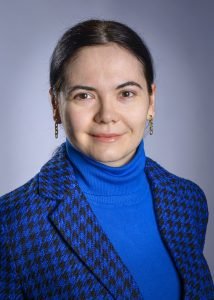
LAVRINENKO OLGA






Dr Olga Lavrinenko – PhD in Sociology (Institute of Philosophy and Sociology, Polish Academy of Sciences, 2020). Assistant Professor and Principal Investigator of the project “Gender Gaps in Political Participation: Examining the Relationships Between Gender Equality and Gender-Role Attitudes in Europe, 1999–2021”, funded by the National Science Centre, Poland (grant no. UMO-2023/51/D/HS6/00026). From 2021 to 2024, Dr Lavrinenko led the project “Fragmentation of Women’s Organizations and Women’s Political Power Worldwide, 1999–2020”, also funded by the National Science Centre (grant no. UMO-2021/40/C/HS6/00150). Previously, she worked as Assistant Professor at the Institute of Philosophy and Sociology, Polish Academy of Sciences, and as postdoctoral scholar in the project “Political Voice and Economic Inequalities across Nations and Time” (NCN grant no. 2016/23/B/HS6/03916). Dr Lavrinenko has presented her research at international conferences, including in Ghent, Tilburg, Ljubljana, Frankfurt am Main, Vienna, Kaunas, Tartu, Porto Alegre, Uppsala, and Stockholm.
Research interests
Political participation, political power, social inequalities, gender studies, political attitudes and behavior, political protest, quantitative methods, mathematical modeling.
Affiliation
Department of Political Sociology and Political Marketing.
Three recent publications:
Lavrinenko, O. 2025. “Fragmentation of Women’s Transnational Social Movement Organizations and Women’s Political Empowerment Worldwide, 1990–2021.” International Journal of Comparative Sociology 66 (4): 560–83. https://doi.org/10.1177/00207152241279299.
Lavrinenko, O. 2024. “WINGOs as Conduits of World Culture, Their Relationships with Emancipative Values, and Women’s Political Empowerment Worldwide, 1981–2020.” International Journal of Comparative Sociology 65 (5): 561–78. https://doi.org/10.1177/00207152231188316.
Lavrinenko, O., J. K. Dubrow, and I. Tomescu-Dubrow. 2022. “Contacting a Public Official: Concept and Measurement in Cross-National Surveys, 1960s–2010s.” Social Science Quarterly 103 (4): 810–19. https://doi.org/10.1111/ssqu.13177.