Programs conducted at the Faculty of Political Science and International Studies (WNPiSM) at the University of Warsaw are the best in Poland according to the “Perspektywy 2026” University Ranking!
June 30, 2026
Application Deadline Extended for META United Nations Summer School 2026
June 30, 2026


Invitation to seminar titled “Authoritarian learning across the pond”
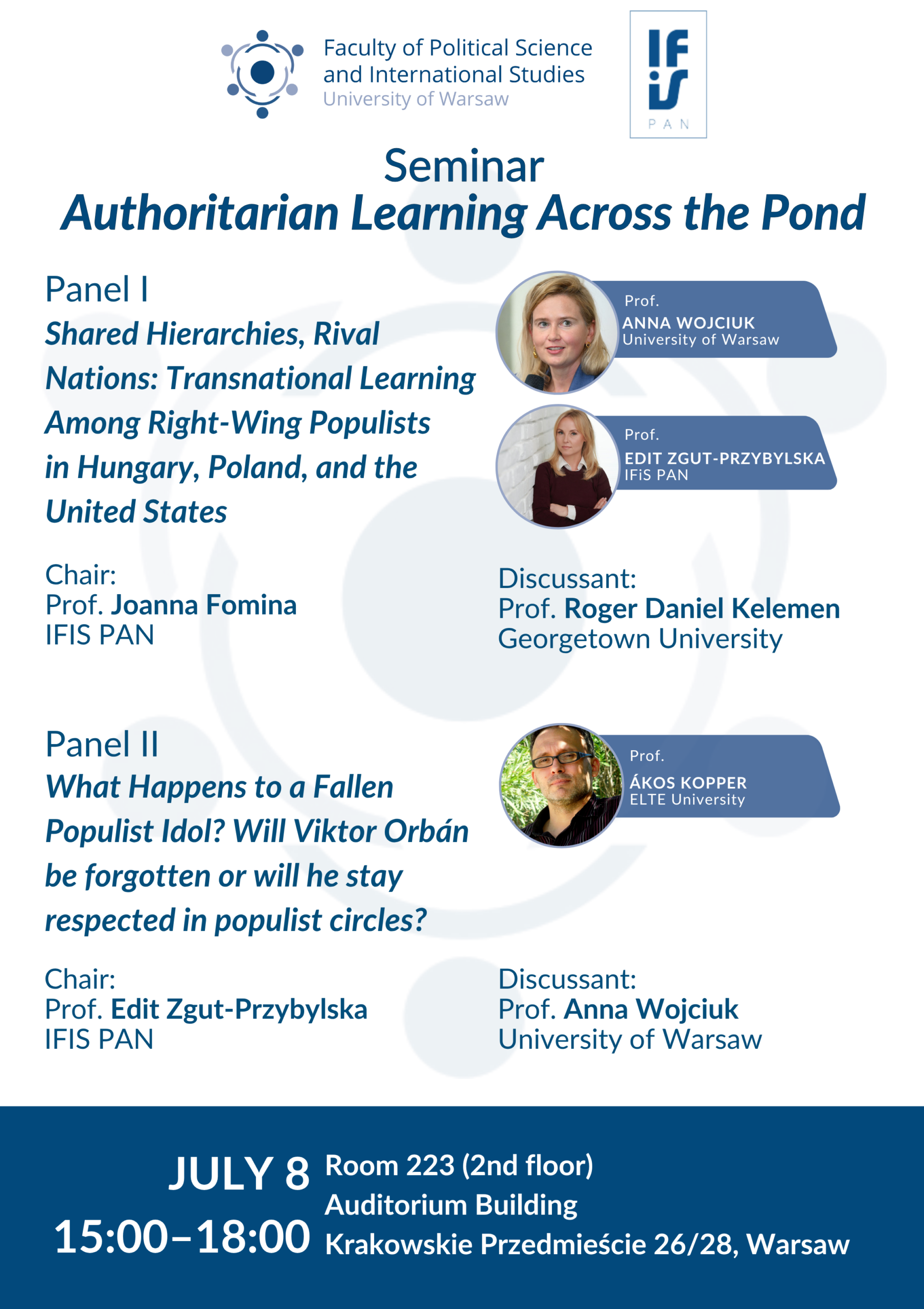
We are pleased to invite you to the seminar titled “Authoritarian learning across the pond”, focusing on the transnational diffusion of populist ideas, practices, and political strategies across Hungary, Poland, and the United States. The seminar is a joint event of the Department of Methodology, Faculty of Political Science and International Studies, University of Warsaw and the European Studies Unit in IFiS (Polish Academy of Sciences).
The seminar will take place on July 8 from 15:00–18:00 at:
Room 223 (2nd floor)
Auditorium Building
Faculty of Political Science and International Studies
University of Warsaw Main Campus
Krakowskie Przedmieście 26/28, Warsaw
The seminar will feature two presentations exploring different dimensions of populist learning, networks, and political influence.
Panel 1
Anna Wojciuk (Professor at the University of Warsaw) and Edit Zgut-Przybylska (Assistant Professor at IFiS PAN) will present their paper:
“Shared Hierarchies, Rival Nations: Transnational Learning Among Right-Wing Populists in Hungary, Poland, and the United States”
Discussant: R. Daniel Kelemen (Associate Dean for Faculty and the McCourt Chair at the McCourt School of Public Policy, Georgetown University)
Chair: Joanna Fomina (Associate Professor at IFiS PAN)
The presentation examines why right-wing populist actors learn from one another across borders while rarely developing stable international alliances. It argues that shared ideological commitments to restoring domestic social hierarchies enable the diffusion of narratives, policy tools, and strategies challenging liberal norms. However, when these ideas enter the sphere of international politics, competing nationalist ambitions often generate rivalry rather than durable cooperation. Drawing on Hungary under Orbán, Poland under PiS, and the United States during and after Trump’s presidencies, our paper analyses how populist actors exchange practices in areas such as migration, family policy, and restrictions on civil society, while highlighting the limits of sustained transnational coordination.
Panel 2
Ákos Kopper (Associate Professor, ELTE University) Presentation title:
“What Happens to a Fallen Populist Idol? Will Viktor Orbán be forgotten or will he stay respected in populist circles?”
Discussant: Anna Wojciuk
Chair: Edit Zgut-Przybylska
The presentation explores the international symbolic role of Viktor Orbán, who for more than a decade was viewed as a model and reference point for populist politicians across Europe and beyond. After the end of this political success story in April 2026, the presentation asks what happens within populist networks when a once-celebrated political figure loses power: How do populist movements respond when their role model falls? Does the image of the “populist success story” disappear, or does it continue to shape political imaginaries?
The joint seminar will provide an opportunity to discuss how authoritarian and populist ideas travel across borders, how political actors learn from one another, and what happens when transnational political models face crisis.
The abstracts and speaker bios are attached to this invitation. Please confirm your participation at a.wojciuk@uw.edu.pl or ezgu